

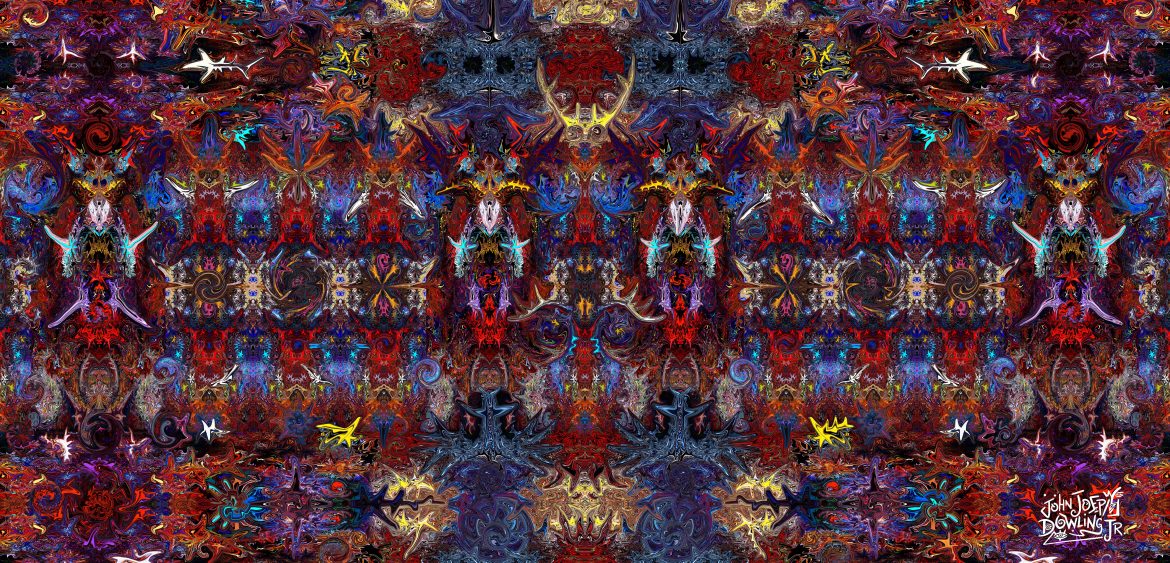
American Graffiti pieces from artist John Dowling before they are compressed for display on social media or on this website can only exist as Photoshops .psb or Large Format Files because they are too big for .jpg compression. A typical file of John Dowling’s American Graffiti art usually measures five feet by five feet and can be as large as twenty-five feet by thirty feet. In these high-resolution samples, each had to be compressed to half their organic size to save properly. There is also a two-gigabyte limit on .jpg files. They were added to these higher-resolution PDF files to see more of the colors and integrate details in the micro abstractions.

THIS FILE IS OVER 2 GIGABYTES AND WILL PROBABLY NOT SHOW IN YOUR BROWSER
The Design Techniques Used To Create These Abstractions
What sets Dowling’s work apart is the interplay of macro and micro detail. The thumbnails or even full-screen digital versions of his pieces hint at their grandeur. However, the true depth of these artworks can only be experienced in print. They need to be printed on aluminum, metallic canvas, or metallic cotton fiber. Up close, the viewer is invited into an entirely different world—one inhabited by “spacelings,” as Dowling affectionately calls them. These abstract, creature-like forms emerge from the intricate details, offering a unique visual discovery for every observer. In addition to spacelings, Dowling’s work includes abstract “totems.” These totems pay homage to the spiritual and cultural significance of traditional Pacific Northwest totem art. The vertical elements in many of his compositions echo the reverence, storytelling, and symbolism found in totem poles. They blend contemporary abstraction with deep historical roots.
Dowling also channels the spirit of the expressionist masters, such as Van Gogh, by utilizing a modified digital impasto technique. Dowling’s compositions pulse with movement and emotion. They are much like Van Gogh’s textured, swirling brushwork in Starry Night or Wheat Field with Cypresses. These swirling graphics replicate the expressive qualities of impasto in a digital medium. They draw the eye into a dynamic dance of color and form. This fusion of tactile energy, vibrant palettes, and intricate detail makes each piece a multi-dimensional experience—both visually and emotionally powerful.
John Dowling’s “American Graffiti” collection is a masterclass in compositional balance.
It demonstrates a deep understanding of both symmetrical and asymmetrical design principles. He seamlessly weaves these concepts into his artwork, creating visually captivating pieces that resonate with viewers on a deeper level. Let’s delve into some of the specific design principles he employs:
Elongated & Symmetrical Portrait:
Dowling often utilizes elongated canvases to create striking portraits that emphasize vertical symmetry. Imagine a portrait of a spaceship. Its sleek lines extend from the top to the bottom of the canvas. The spaceship’s central axis serves as the dividing line. This elongation accentuates the car’s form. It also draws the viewer’s eye along its length. This highlights the car’s elegance and power.
The symmetrical composition further enhances the portrait’s impact. The spaceship’s perfectly mirrored features create a sense of balance. This harmony allows the viewer to appreciate its design. The details are observed without distraction. This technique effectively captures the essence of classic American automobiles, showcasing their timeless beauty and iconic status.
Kaleidoscope Radial Symmetry:
Dowling’s fascination with radial symmetry is evident in his kaleidoscopic compositions. Imagine a circular canvas filled with vibrant colors and intricate patterns radiating from a central point. This technique creates a mesmerizing effect, drawing the viewer’s eye into the heart of the design.
He often incorporates elements like wheels. He uses abstractions that represent hubcaps as focal points. He also uses the circular headlights of classic cars in his radial compositions. The spokes of the wheel act as radiating elements. The intricate patterns on the hubcap add to this effect. The concentric circles of the headlights also contribute, creating a sense of dynamism and visual interest. These kaleidoscopic designs evoke a sense of wonder and nostalgia. They remind viewers of childhood toys and the simple pleasures of a bygone era. They also symbolize the cyclical nature of time and the enduring legacy of American automotive design.
Design Principles: Visual Perception and the Principles of Gestalt
Dowling’s work demonstrates a keen understanding of Gestalt principles, which explore how humans perceive and organize visual information. He utilizes these principles to create compositions that are both visually engaging and emotionally resonant.
- Similarity: Dowling groups similar elements together, such as a series of vintage gas pumps or a row of classic cars. This creates a sense of unity and cohesion in his compositions.
- Proximity: The placement of elements in close proximity to each other suggests a relationship or connection. This allows viewers to interpret the artwork in a meaningful way.
- Closure: Dowling often uses incomplete shapes or lines. He relies on the viewer’s mind to complete the image. This creates a sense of closure. This technique encourages active participation and adds a layer of intrigue to his artwork.
- Continuity: Dowling uses lines or shapes that flow smoothly from one element to another. This guides the viewer’s eye through the composition. It creates a sense of movement and rhythm.
- Figure-ground: Dowling masterfully plays with the figure-ground relationship, creating ambiguity and visual interest. A classic car might emerge from a busy background. A cityscape might dissolve into an abstract pattern. This challenges the viewer’s perception and invites them to explore the interplay between foreground and background.


